
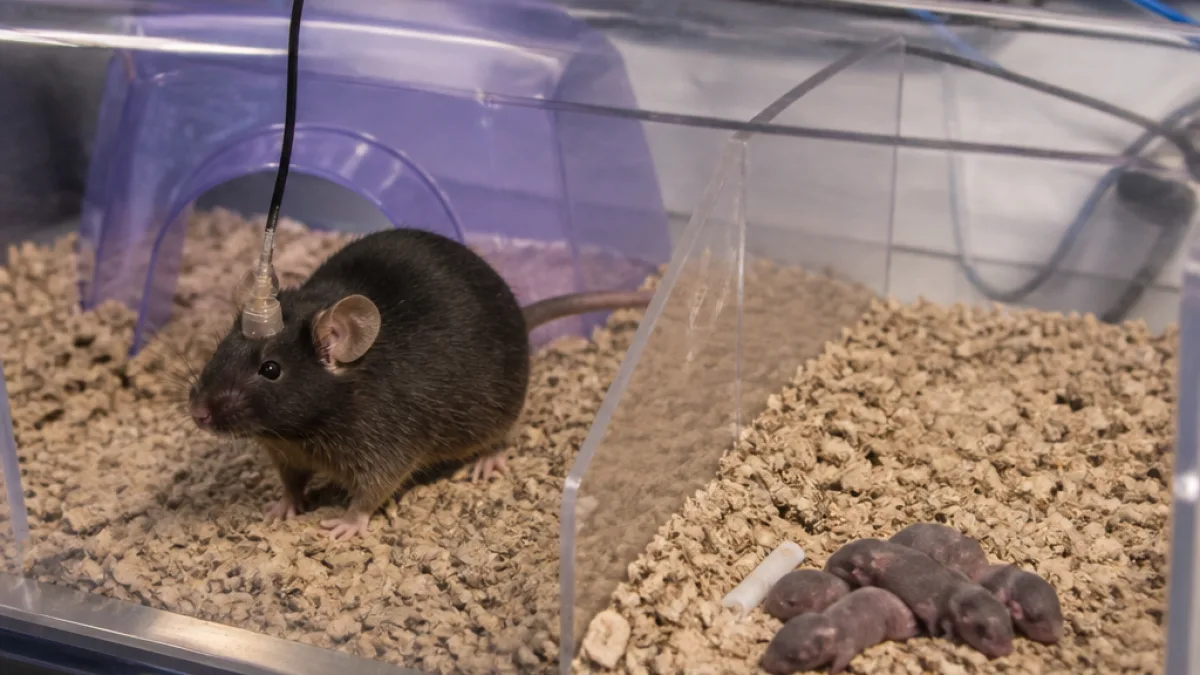
Researchers at Southern Medical University have identified a neural pathway that appears to help mother mice wake in response to calls from their pups, according to a study published in Nature Neuroscience. The work examines one possible biological mechanism behind sleep disruption after childbirth.
Interrupted sleep is common for many new mothers. A newborn’s crying can wake a mother even when another caregiver is available, and repeated interruptions can affect the amount and continuity of sleep. Feixue Liang, the study’s senior author, said postpartum sleep fragmentation is considered an important contributor to physical and mental health problems.
“One major reason for this disrupted sleep is that mothers are particularly sensitive to their babies’ cries and can be easily awakened by them.”
Liang and colleagues used mice to investigate how the brain detects a pup’s call during sleep. The researchers recorded brain and muscle activity in sleeping female mice, including mothers and females that had never mated or cared for pups. Brain activity was measured with electroencephalography, or EEG, while electromyography, or EMG, was used to track electrical activity in the muscles.
The researchers’ earlier observations found that mother mice, like human mothers, appeared to wake quickly when their young called. That similarity led the team to examine the underlying circuitry in greater detail. Mice are often used in this type of research because their brains can be studied in controlled experimental settings.
What the experiment examined
- Participants: Sleeping female mice that included mothers and females without previous mating or pup-care experience.
- Measurements: Brain activity through EEG and muscle activity through EMG.
- Focus: The neural pathways involved in selectively waking in response to offspring calls.
Liang said the study aimed to identify the specific brain circuits that allow mothers to recognize their offspring’s calls and awaken during sleep. The researchers’ findings concern mice, not people, and the experiment does not establish that the same pathway produces the same response in human mothers.
The study adds to research into the relationship between caregiving, sleep and the nervous system. Its focus is not on eliminating nighttime waking, but on examining how the brain responds to a particular sound during sleep and how that response differs between mothers and females without caregiving experience.
For people experiencing sleep disruption after childbirth, the research is a laboratory finding rather than individualized health guidance. The work provides a basis for further study of the biological processes associated with postpartum sleep fragmentation while keeping the distinction between animal research and human health outcomes.