
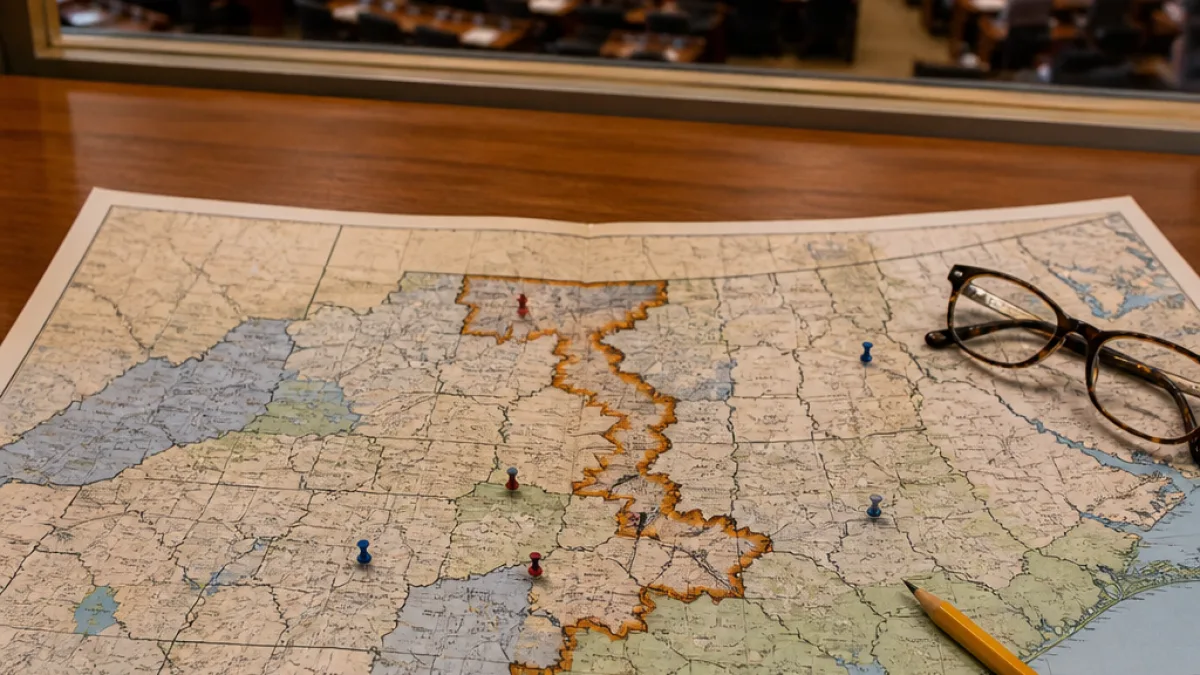
The Republican-controlled North Carolina legislature redrew the state’s 13th Congressional District after the 2022 election, carving out Democratic voters in Raleigh and adding rural counties to produce a markedly safer Republican seat, according to reporting and interviews in Raleigh and Garner.
Former Democratic Rep. Wiley Nickel narrowly won the district in 2022 by about 9,000 votes, but the current congressman, Republican Brad Knott, won the seat in 2024 by more than 70,000 votes, an outcome the coverage attributes to the changed boundaries rather than a sudden shift in voter sentiment.
Voters’ geography reshaped
The legislature’s new map split the district into an hourglass shape, moving pockets of Democratic voters out of the 13th and replacing them with a stretch of rural counties that extend north to the Virginia border. The change reduced the district’s competitiveness and contributed to larger national trends: reporting shows the number of swing seats — defined as districts a presidential candidate carried by 5 percentage points or fewer in the prior election — fell from 45 to 37 over the past year.
“Voters didn’t change their minds. Politicians changed their voters.” — quoted in coverage
why the change matters
Analysts and the reporting place the North Carolina example in a broader pattern: over decades, partisan sorting, demographic shifts and targeted redistricting have steadily reduced the number of competitive House districts. One historical comparison cited in the coverage notes that about 96 House seats fit a modern definition of a swing seat in 1964, a figure referenced from a count discussed in reporting from the 1970s.
- Mapmaking and power: State legislatures that control redistricting can significantly alter the political balance in particular districts.
- Electoral consequences: When districts are made safer for one party, general elections can become decided more by primary contests than by competitive general campaigns.
- National trend: The decline in swing districts has accelerated recently, according to the reporting, with implications for congressional polarization and campaigning.
The reporting includes portraits of candidates and on-the-ground observations from towns in the 13th District, illustrating how the new boundaries have changed local campaign dynamics and the appearance of political signs in formerly competitive neighborhoods. It also cites vote margins that show the contrast between the narrow 2022 result and the larger 2024 Republican victory.
State legislatures redraw congressional maps every 10 years after the census, but some recent cycles have included mid-decade map changes and legal challenges. The North Carolina example underscores how those processes intersect with broader demographic and partisan trends to reshape which House seats are genuinely competitive.
No legal ruling or pending action related to the district map is described in the coverage cited here; the story centers on the observed electoral outcomes and expert and journalistic analysis of competitiveness trends.